Oborevwori Signs Five Laws, Grants Legal Backing to 13th-Month Salary for Delta Workers
Delta State Governor, Sheriff Oborevwori, has signed five bills into law, introducing changes to workers’ welfare, judicial capacity, property protection and the state’s revenue administration.
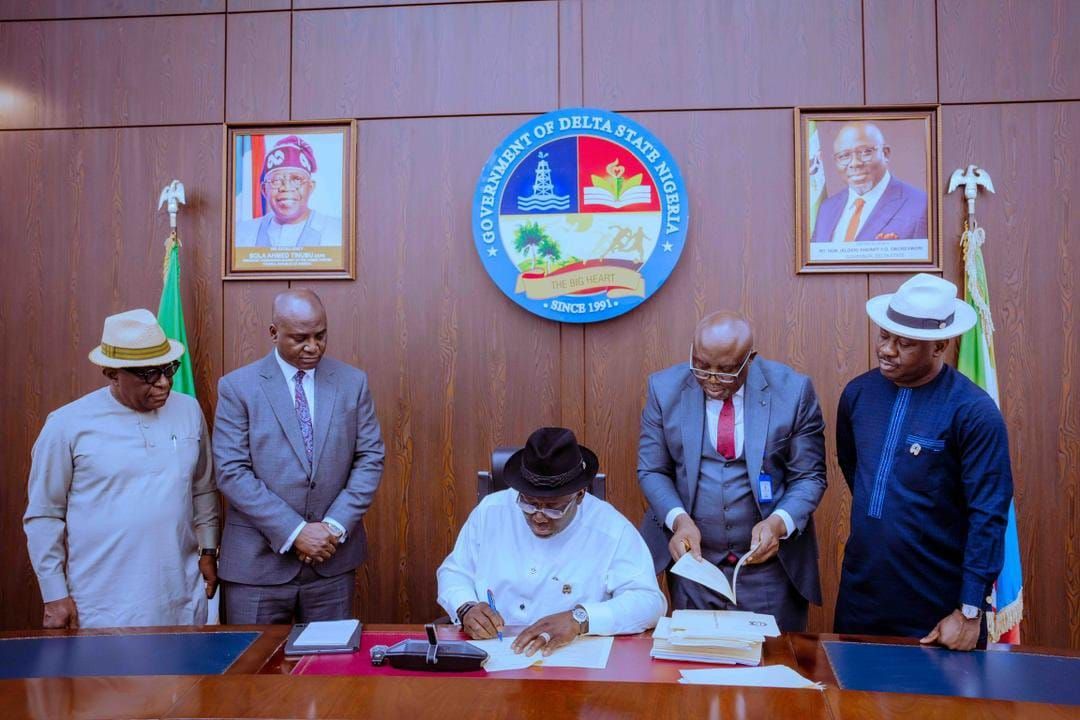
The new laws include legislation providing legal backing for the payment of a 13th-month salary to state workers, amendments increasing the number of judges in the High Court and Customary Court of Appeal, and measures aimed at protecting public and private property.
The governor also signed the Delta State Revenue Service (Consolidated) Law, 2026, which seeks to harmonise taxes and levies, strengthen revenue collection and reduce the burden of multiple taxation on businesses and residents.
The bills, which were passed by the Delta State House of Assembly, were presented to Oborevwori by the Speaker, Emomotimi Guwor, at Government House in Asaba.
Under the 13th-Month Salary Law, 2026, the payment of an additional month’s salary to Delta State workers receives statutory backing. The implementation details, including eligibility and payment arrangements, were not provided in the announcement.
The High Court Amendment Law, 2026, increases the number of High Court judges in the state from 45 to 50, while the Customary Court of Appeal Amendment Law, 2026, raises the number of judges in that court from nine to 12.
The amendments expand the authorised number of judicial officers in both courts, although the announcement did not specify when the additional positions would be filled.
Another of the new laws, the Public and Private Properties Protection (Amendment) Law, 2026, strengthens measures for safeguarding property and provides for the establishment of a task force to enforce its provisions.
The task force is also expected to support the recovery of public assets and work with relevant law enforcement agencies in carrying out its responsibilities.
The Delta State Revenue Service (Consolidated) Law, 2026, is designed to streamline the administration of taxes and levies, improve compliance and make it easier to do business in the state.
The law is also intended to reduce multiple taxation and align the state’s revenue administration with the 2025 national tax reforms.
The five laws touch on areas with direct implications for public sector employees, court administration, property owners, businesses and the state’s internally generated revenue.
However, the announcement did not provide detailed implementation timelines for the new provisions, including the commencement of the 13th-month salary payments, recruitment of additional judges or operational arrangements for the property protection task force.
The governor’s assent brings the five bills passed by the State Assembly into law, with their practical impact expected to depend on implementation and the relevant administrative arrangements.
Enjoyed this? Get the morning brief.
News from Nigeria and Africa, in one free email every day.