Umahi Gives CCECC 14-Day Deadline to Fix Bad Sections of Benin–Asaba Highway
The minister ordered repairs at Ubulu-Okiti and Onicha-Ugbo during an inspection, saying motorists must not suffer regardless of payment delays.
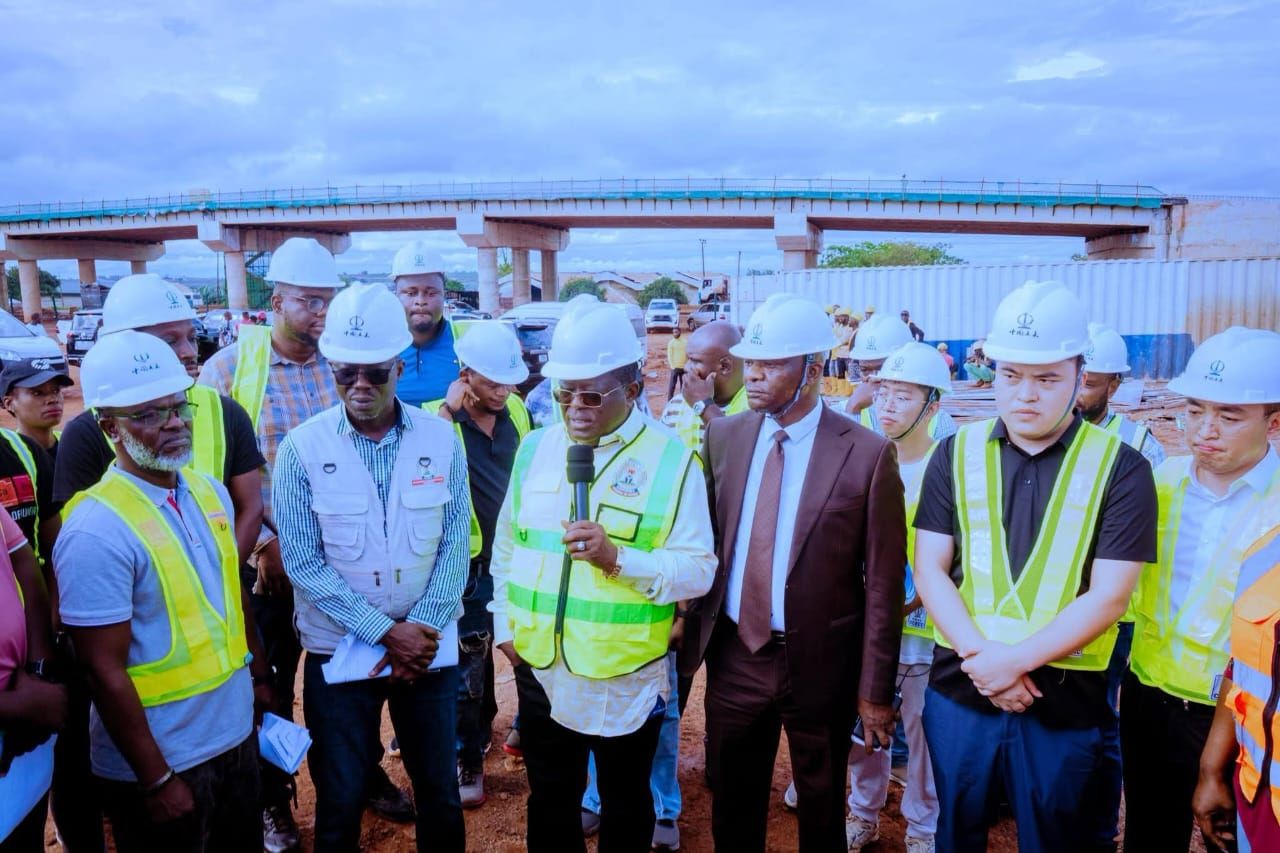
Minister of Works, David Umahi, has given China Civil Engineering Construction Corporation (CCECC) a 14-day ultimatum to repair badly damaged portions of the Benin–Asaba Highway and restore affected service lanes around the access road to the Second Niger Bridge.
Umahi issued the directive during an inspection of the Asaba axis of the project on Thursday, following complaints over difficult road conditions and the delays being experienced by motorists along parts of the corridor.
The minister particularly identified the Ubulu-Okiti and Onicha-Ugbo areas as locations requiring urgent attention, warning that road users should not be left to bear the consequences of ongoing construction work.
He ordered the contractor to restore sections where asphalt had been removed, including service lanes linking motorists to the Second Niger Bridge access route.
“I am giving you 14 days to fix the access, the service lane you removed the asphalt,” Umahi told the contractor.
“You have to fix it immediately, whether you are paid or not. It is my right to insist that you fix it to lessen the problem of the people.”
He also called for immediate work on the stretches between Chainage 103 and 105, as well as Chainage 106 and 107, which he said had deteriorated and were making movement difficult for both motorists and vehicles conveying construction materials.
According to Umahi, the affected portions cover about four kilometres of dual carriageway and require emergency intervention.
The minister said the Ministry of Works was capable of fixing the damaged areas within the two-week period but had been limited by the concession arrangement covering the road.
He said the Federal Government had already raised concerns with the concessionaire over the poor maintenance of parts of the highway and had previously exercised caution because of the terms of the agreement.
However, Umahi said the situation had reached a point where intervention could no longer be delayed.
“We cannot continue to allow Nigerians to suffer,” he said, noting that some travellers had spent hours, and in extreme cases days, trapped in traffic along the route.
The minister also faulted the handling of some portions of the road where old asphalt had been removed but not properly reinstated, particularly between kilometre eight and kilometre 15.
He expressed concern over reports that some newly laid asphalt failed barely a day after it was applied, describing the development as unacceptable and raising questions about the quality of work.
Umahi said the government would continue to pursue lawful options to protect motorists and keep a major economic corridor linking Delta, Edo and other parts of the country functional.
Speaking on the Second Niger Bridge access road, Umahi said completing the project remained a priority because the bridge could not deliver its full benefits without reliable connecting infrastructure.
He pointed to the strategic importance of the Second Niger Bridge, especially considering the age of the First Niger Bridge, which has served the region for more than six decades.
“The essence is to use that Second Niger Bridge,” Umahi said. “Because if the First Niger Bridge collapses, the beautiful job on the Second Niger Bridge will be rendered useless.
The N148 billion project, being handled by CCECC, includes the construction of flyovers, bridges, culverts and rigid pavement sections.
Umahi said approximately 4.47 kilometres of the dual carriageway had been completed, representing about 26.7 per cent of the project, while work had also advanced on retaining walls, culverts and other supporting infrastructure.
Although funding under the NNPC tax-credit arrangement had ended, the minister said President Bola Ahmed Tinubu had approved another funding option to keep the project moving.
He urged CCECC not to slow down work because of funding concerns.
“I encourage you to please go ahead, you will be paid. Please go ahead, you will be paid,” Umahi said.
He warned that leaving completed structures unattended could expose them to erosion and lead to additional costs for the government.
Umahi commended the contractor for the progress and standard of work recorded on the project despite the funding challenges.
Delta State Commissioner for Works (Rural Roads) and Public Information, Charles Aniagwu, who represented Governor Sheriff Oborevwori, praised the minister for personally inspecting the troubled sections of the federal highway.
Aniagwu said the poor state of parts of the Benin–Asaba–Niger Bridge and Benin–Warri corridors had become a major source of concern for road users.
According to him, the minister’s visit showed that complaints from motorists were receiving attention.
He added that the Delta State Government had carried out interventions along parts of the corridor, including work around Chainage 64 to 65, and expressed optimism that contractors handling other projects would increase the pace of work before the Yuletide period.
Aniagwu said completing the various road projects would improve traffic flow between Delta and Edo states and strengthen commercial activities along the busy corridor.
Also speaking, the Director of Highways, Bridges and Design at the Federal Ministry of Works, Saidu Musa, said the Second Niger Bridge access project was awarded in March 2025 for N148 billion.
He said more than 4.4 kilometres of dual carriageway had been executed, alongside progress on retaining walls, culverts and other components of the project.
Musa commended the quality of work so far and said faster progress would have been possible with more consistent funding.
Enjoyed this? Get the morning brief.
News from Nigeria and Africa, in one free email every day.