NUJ Delta Pushes Stronger Oil and Gas Journalism Through Capacity Building
Council chairman Churchill Oyowe told journalists at an Asaba workshop with Chevron that technical knowledge and ethics underpin credible petroleum reporting.
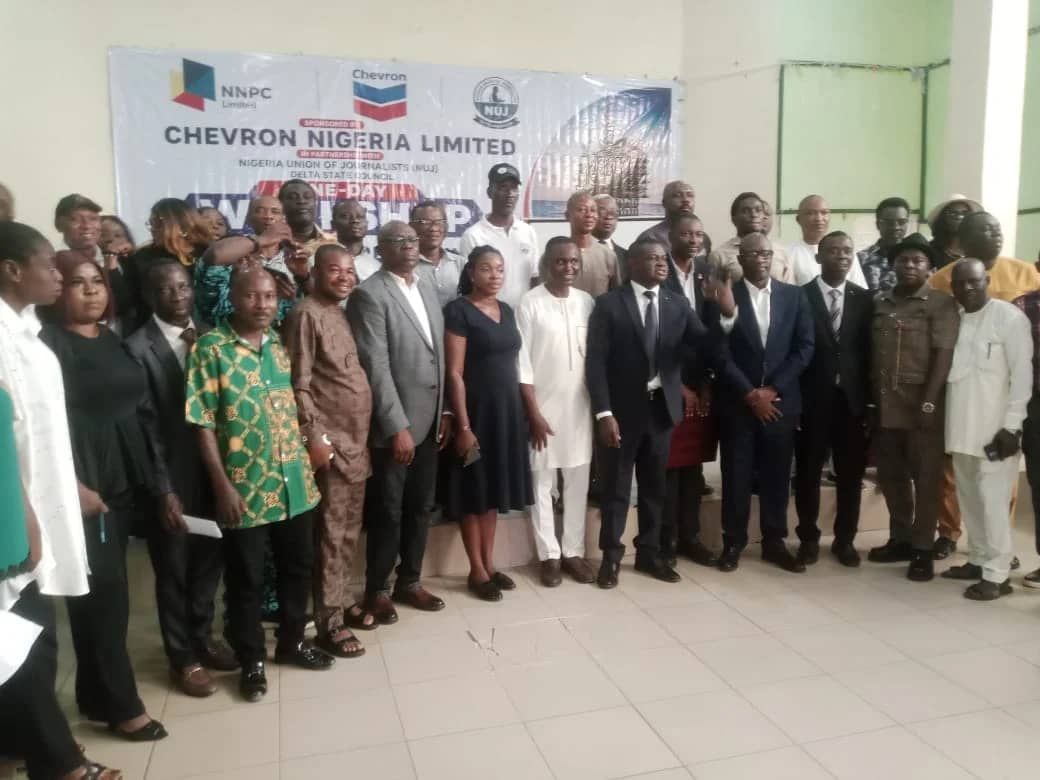
The Nigeria Union of Journalists (NUJ), Delta State Council, has renewed its call for continuous professional training of journalists, stressing that better-equipped reporters are essential to credible, ethical and public-interest journalism.
The council’s chairman, Comrade Churchill Oyowe, made the call on Monday, August 24, 2026, while welcoming participants to a one-day workshop on oil and gas reporting at the NUJ Press Centre, Maryam Babangida Way, Asaba.
The workshop, organised in partnership with Chevron Nigeria Limited, is themed “Enhancing Professional Skills and Ethical Standards in Oil and Gas Journalism.”
Oyowe said the training was particularly relevant because the oil and gas industry remains closely tied to Nigeria’s economy, energy security and development.
He challenged journalists to see their role as more than simply reporting events, arguing that the media has a responsibility to help citizens understand complex issues through accurate, balanced and properly contextualised reporting.
According to him, the challenge becomes greater when covering the oil and gas sector because of its technical nature, economic importance and potential impact on communities and the environment.
“Oil and gas journalism requires more than the ability to write a good story,” Oyowe said.
He explained that journalists covering the sector need a working knowledge of its value chain, regulatory environment, environmental issues, host-community relations, energy transition and the economic interests surrounding petroleum operations.
The NUJ chairman also stressed the importance of accuracy, fairness and professional ethics, particularly when reporting issues involving powerful institutions, corporations, government agencies and affected communities.
Oyowe said the workshop was designed to give journalists practical tools for stronger reporting, including the ability to ask more informed questions, interpret technical information and produce stories that provide the public with meaningful context.
He encouraged participants to actively engage with facilitators, ask difficult questions and share experiences from their own reporting assignments.
The ultimate test of the training, he noted, would be whether the knowledge gained translates into more rigorous journalism and better-informed public conversations about Nigeria’s oil and gas sector.
Oyowe commended Chevron Nigeria Limited for supporting professional development and sustained engagement with journalists, while also acknowledging the contributions of NNPC Limited, resource persons and facilitators.
He reaffirmed the Delta NUJ Council’s commitment to regular capacity-building programmes, arguing that journalism can only effectively serve the public when reporters continually update their knowledge and professional skills.
The workshop brings together journalists to examine the demands of reporting one of Nigeria’s most influential and closely watched sectors, with emphasis on professional competence, ethics, accuracy and public-interest journalism.
Enjoyed this? Get the morning brief.
News from Nigeria and Africa, in one free email every day.